Apple Releases AirPods 4, Adds Hearing Aid Mode to AirPods Pro 2
Along with the new iPhone 16 lineup and Apple Watch Series 10, Apple devoted significant attention during its Glowtime event to the AirPods, updating each of the three models to varying degrees. The company introduced the redesigned AirPods 4, unveiled new hearing health features for the existing AirPods Pro 2, and gave the pricey AirPods Max new colors and a USB-C charging port. Don’t look for more about the AirPods Max; that’s all there is to say.
AirPods 4 and AirPods 4 with Active Noise Cancellation
Apple loves to talk about how much work it puts into designing things like the AirPods. Rather than just having its designers play with some modeling clay until they had something that worked pretty well for everyone in the office, Apple explained the process like this:
The new design is built with an unparalleled data set that uses advanced modeling tools, like 3D photogrammetry and laser topography, to precisely map and analyze thousands of ear shapes and over 50 million individual data points in total. This process helped refine the design to deliver the most comfortable AirPods ever with one shape that naturally fits even more users around the world.
Lovely sounding, but from the individual’s perspective, immaterial. Either the AirPods 4 are comfortable in your ears or they’re not. If you previously didn’t like the way the AirPods fit, you can try again because these new ones are different. Simultaneously, however, if the previous AirPods fit well, we can’t assume that the new ones will be the same.
Apple also touts the AirPods 4’s higher audio quality over the previous generation. Terms like “new acoustic architecture,” “low-distortion driver,” and “high dynamic range amplifier” also sound great but don’t mean much to anyone outside the audio industry. We can hope all that comes down to music sounding better to your ears, but only testing will reveal the answer.
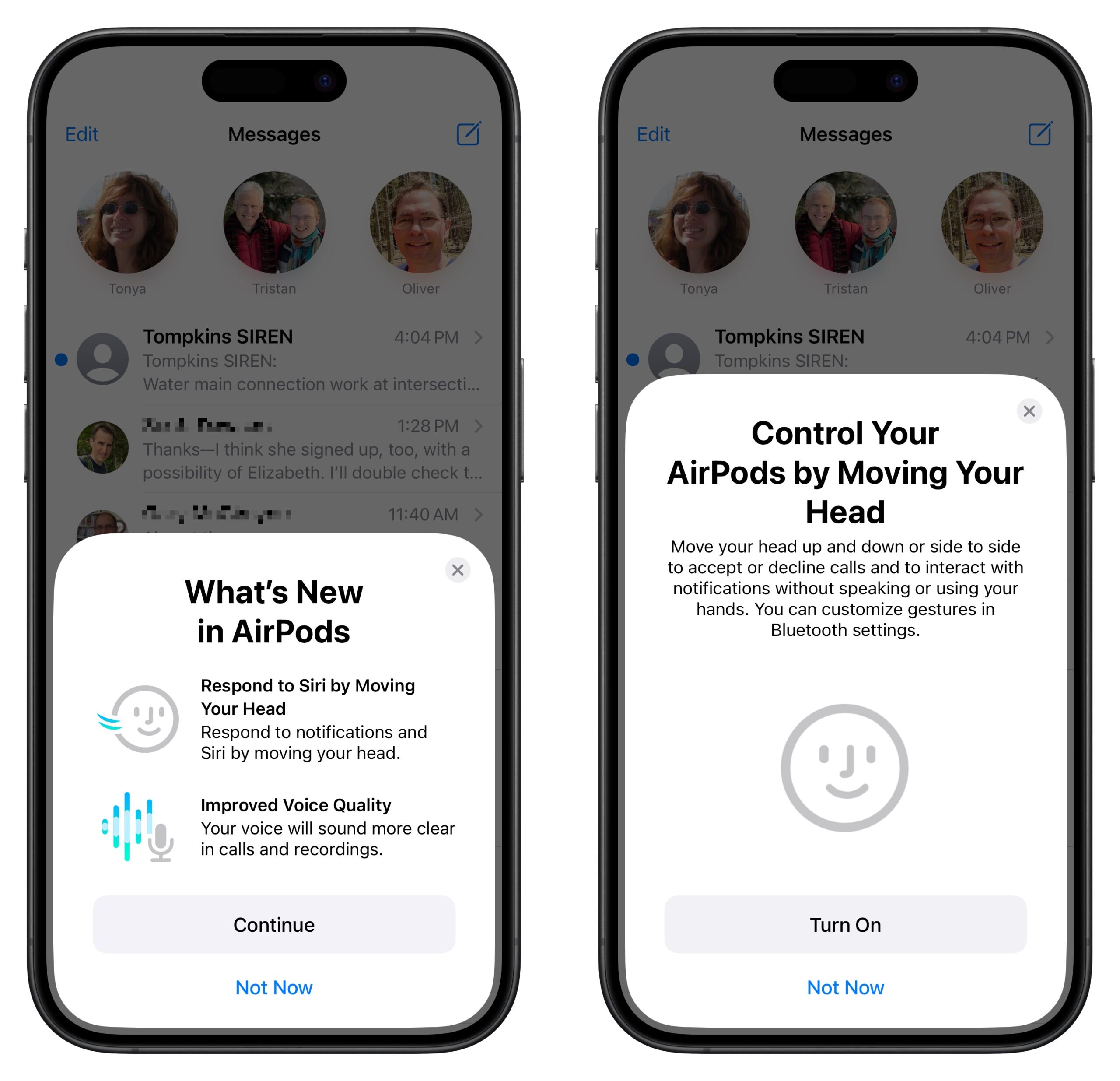
More concrete are the benefits of Apple’s new H2 chip, which provides voice isolation for calls, reducing ambient background noise for clearer call quality. The H2 chip also enables Siri Interactions, which means that when Siri asks you a Yes/No question, you can nod your head yes or shake it no. (I wonder if there’s an option to reverse those motions for iPhones in Bulgaria.) In fact, this feature just shipped in the firmware update 7A294 for the AirPods 2—it installs automatically and will alert you when it does.
However, the H2 chip really shines with the second model of AirPods 4, the AirPods 4 with Active Noise Cancellation. Although the two models are externally identical, the AirPods 4 with Active Noise Cancellation are much closer in capability to the AirPods Pro, sporting modes for Active Noise Cancellation (which reduces background noise), Transparency (which lets you hear sounds around you), and Adaptive Audio (which blends the two for changing environments). Also supported is Conversation Awareness, which senses when you’re talking and automatically lowers media volume, restoring it when you’re done. A footnote suggests that the AirPods Pro 2 provide twice the noise cancellation of the AirPod 4 (or the original AirPods Pro), likely because of the ear tips that provide additional passive noise cancellation.
If having two models whose names differ only in the subtitle isn’t confusing enough, the AirPods 4 with Active Noise Cancellation come with a charging case that’s more capable than the plain USB-C version that ships with the AirPods 4. The case for the AirPods 4 with Active Noise Cancellation can also charge wirelessly from an Apple Watch, Qi, or MagSafe charger, though it won’t stick to a MagSafe charger.
The standard AirPods 4 model costs $129, while the AirPods 4 with Active Noise Cancellation are $179. You can pre-order now, with availability starting on 20 September 2024.
Hearing Health with AirPods Pro 2
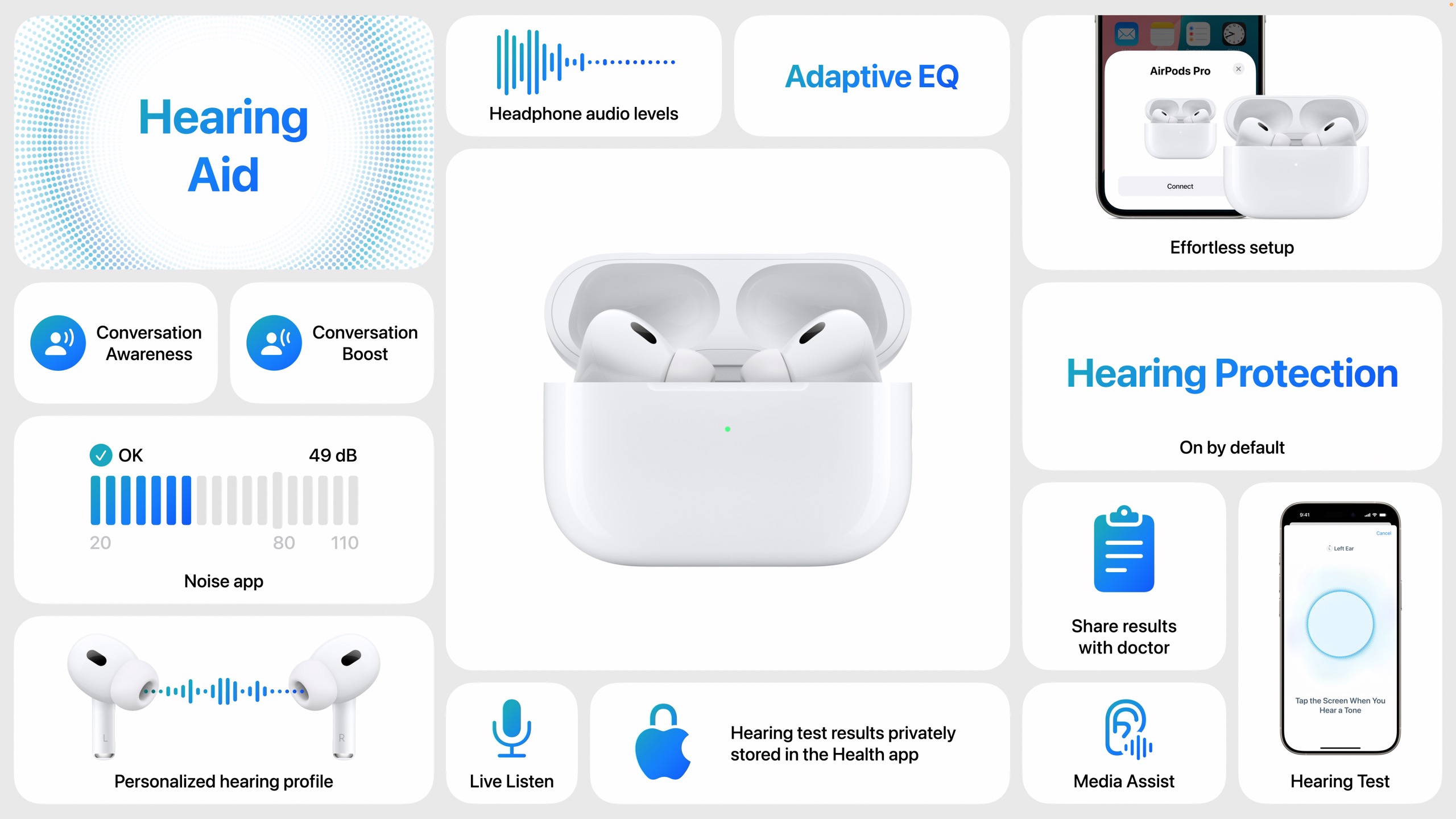
Particularly for the TidBITS audience, which trends older, I was more intrigued by Apple’s announcements of hearing health features coming to the existing AirPods Pro 2. Apple aims to improve awareness with the Hearing Test feature, provide assistance with the Hearing Aid mode, and help with prevention with the Hearing Protection feature.
Apple was justifiably confident that the Hearing Test and Hearing Aid features would receive approval from the US Food and Drug Administration; the FDA just announced its approval. Presumably, other national regulators are likely to follow suit since Apple said it expects to have availability in over 100 countries and regions this fall. Oddly, Hearing Protection will be available only in the US and Canada, though I assume Apple plans to bring it to other countries eventually.
All the features work only with the AirPods Pro 2 with the latest firmware when paired with an iPhone, iPad, or Mac running iOS 18, iPadOS 18, or macOS 15 Sequoia or later.
Awareness
Hearing loss is extremely common, affecting over 60 million Americans and as many as 1.5 billion people worldwide. More than 30% of people 65 and older have hearing loss, a number that climbs to 40% for those age 75 and older. Hearing loss can adversely affect an individual’s quality of life and ability to function, and it has been associated with an increased risk of falls, hospitalizations, social isolation, and cognitive decline.
Apple said that 80% of adults in the US haven’t had their hearing checked in the last five years. That’s a large number, but unless they had reason to be concerned about their hearing, few people would think to schedule a hearing test or even ask about it during an annual physical. You shouldn’t feel bad if you haven’t been tested; the US Preventive Services Task Force was unable to determine the benefits and harms of screening for hearing loss in asymptomatic older adults.
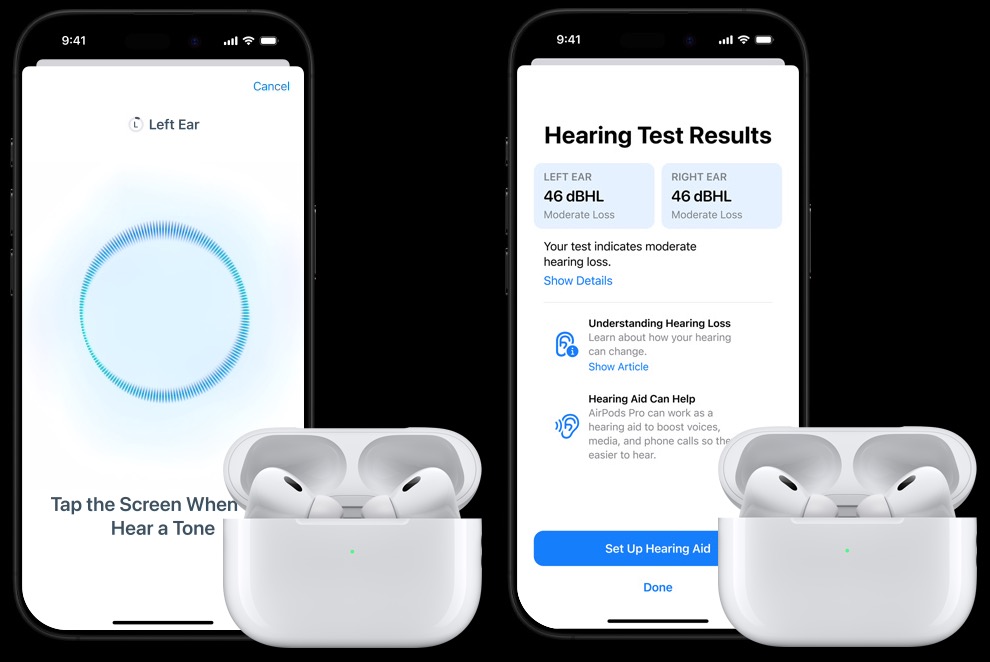
Nevertheless, Apple has added a pure-tone audiometry test that you can invoke from the Health app or the AirPods settings. This sort of test is the most common hearing test for adults, and it measures the quietest sounds you can hear at different frequencies. Apple’s clinically validated Hearing Test takes about 5 minutes to complete and provides immediate results. Since you can retake the Hearing Test whenever you want, it becomes easy to monitor your hearing over time.
Assistance
If your results aren’t bad, but you have trouble with certain frequencies, the Hearing Test offers to adjust your settings for a new Media Assist feature so you can better hear audio on media and calls while using the AirPods Pro 2. If you do experience mild to moderate hearing loss, the Hearing Test prompts you to set up the new Hearing Aid feature.
The Hearing Aid feature leverages the capabilities of Apple’s H2 chip to boost the necessary frequencies, turning the AirPods Pro 2 into what Apple calls a “clinical-grade hearing aid.” It also uses machine learning to make real-time adjustments as your environment changes. You can also fine-tune the balance, amplification, and tone at any time.
We won’t know how well the AirPods Pro 2 will compete with dedicated hearing aids until the feature becomes available. Given the extremely high cost and finicky usage of prescription-level hearing aids, I expect many people who wouldn’t otherwise consider hearing aids will appreciate a little boost. If that proves to be the case, constant wearing of Apple’s white earbuds may become as common among older adults as it is among teens.
Prevention
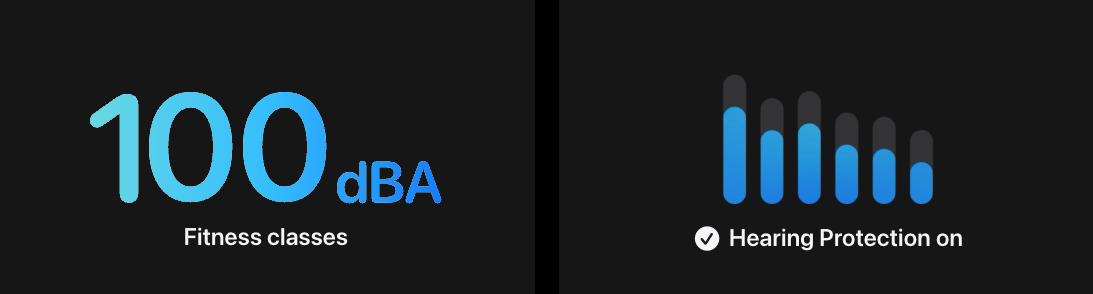
Of course, the best scenario is not to need any hearing assistance at all. To that end, Apple has added active Hearing Protection across all the AirPods Pro 2 listening modes (Active Noise Cancellation, Transparency, and Adaptive Audio) to help prevent exposure to loud noises. Hearing Protection can lower sound levels in environments as loud as 110 dBA by actively canceling intermittent sounds 48,000 times per second.
I’m curious if Hearing Protection will be sufficiently good that people—again, older adults—will start wearing AirPods Pro 2 in scenarios where they’re purely trying to protect their hearing. We try to bring earplugs whenever we go to a concert because Tonya is particularly sensitive to loud sound, but it seems likely that the AirPods Pro 2 would provide a more enjoyable listening experience.
Even though I wear them relatively infrequently myself, I’ve been plugging wireless earbuds for years, even back when Apple focused its advertising on its wired earbuds (see “Anecdotes about New Apple Fellow Phil Schiller and Marketing Chief Greg Joswiak,” 10 August 2020). We’ve been paying attention to how Apple devices can help with hearing for years, starting with Jeff Porten’s “iOS Hearing Aids… or, How to Buy Superman’s Ears” (8 February 2011), which Apple turned into its Live Listen feature. Subsequently, Apple has introduced Conversation Boost in AirPods Pro, which focuses what you hear on the person in front of you. These new features are even more promising.


I have Beats Fit Pro earbuds which I use when working out (and occasionally at other times; when I’m doing some boring chores like painting for example) and wasn’t otherwise in the market for AirPods, but the hearing aid approval is making me consider getting Pro 2 earbuds just for that. I can get by without hearing aids right now, but I know I’ll need them at some point, and this may be good enough for a while at $250 a pair rather than the expense of real hearing aids.
I’m really curious how similar the actual in-ear bud is on the new 4s compared to the previous 3s.
My wife would like ANC, but she can’t stand the fit and feel of the Pros. She does prefer the fit and feel of her work 3s over her old personal 1s. The buds on the new 4s look very much like those on the 3s, stalk too in fact. So if the new buds, in spite of all of Apple’s schmoozing about laser scanning 50 gazillion ears to achieve best fit, are essentially the same as the 3s, that would probably be a perfect upgrade for her old 1s (and finally, die Lightning, die!).
The AirPods Max “upgrade” is just sad. I really want to like them, and in principle I’d be happy with a switch to USB-C, but I’m afraid I just can’t justify such a trivial upgrade. I had hoped for at least a new signal processor, perhaps with the upgraded transparency controls that the Pro have. But alas.
Speaking of which, you can already, as alluded to in the article, customise transparency mode to increase amplification, in effect giving you makeshift hearing aids. But bugs make them a risky proposition that only a fool like me would entertain. (But I must say that it does work well, when it works.) If they can make those bugs go away so the mode stays on correctly, and loud sounds are not improperly suppressed (a pelican warning, for instance) then we might just be onto something.
This potential development has been covered in previous Tidbits discussions such as:
Since they become a “medical device” all sorts of approvals are needed in various regions and countries but the US FDA approval is a giant step.
As I read on another website, this could revolutionise the hearing aid industry with significant price competition.
The biggest thing to me is the ability to do regular clinical-grade hearing tests at home. Even if I don’t have hearing loss now, it is so gradual, it will be great to have a baseline to look back on in 5-10 years and see how my hearing has changed. (Just like having years of watch heart data could help with future heart trouble.)
I definitely have hearing loss. Would like to track it. Curious as to how good the AirPods will be.
There are apps that can do hearing tests now if you want to start. I’ve used this one:
I do a test once a year or so. What’s been good about this app is that it can create an audiogram that you can apply in the accessibility settings that will boost specific frequencies during media playback. And its results also can be recorded in the health app. But, yes, I still like that Apple will have their own built-in testing app.
So will Apple’s hearing test actually be saved to an archive of sorts so I can follow deterioration over time? I know I have hearing loss. What I don’t know is how it’s progressing.
Yes, there is already a section in the Health app for it. (Audiogram under hearing). And Apple said as much in the keynote on Monday.
Mine, for example. November 2022 and February 2024.
I’m going to try to keep this as short and to the point as possible. My hearing loss broke my heart. As a musical wind instrument performer, when I became aware 2 years ago that my hearing loss was preventing me from performing at an acceptable level, I chose to end my performance participation rather than wait to be asked to leave. I am an owner of some of the most expensive commercial hearing aids that are available for consumers. They help, but they can’t allow me to continue to perform on my primary instrument, partly because the loudness level of the instrument overdrives the input section (microphone) of the hearing aids, making it impossible to use them while playing. When I purchased my AirPods Pro 2 a few months after purchasing my latest pair of hearing aids, I was immediately aware that the hearing aid options mentioned in Apple’s recent announcement should be possible. I don’t expect for my specific impairment to ever be artificially remedied to the extent needed to allow me to resume performing at the level to which I was accustomed when I stopped. I do hope, however, that these advances in Apple’s technology may contribute to consumers’ options toward overcoming some of the feelings of helplessness that can encompass efforts to find an effective remedy.
Isn’t the somewhat short time between charges going to be an impediment to widespread use of AirPods as hearing aids for slight-to-moderate hearing loss?
Users of the popular Oticon rechargeable prescription hearing aids say they easily run the entire waking day on an overnight charge.
Surely Apple can do better than AirPod’s 4+ hours between charges (albeit fast) if they hope to break into this medical hearing aid market.
For casual use as a hearing enhancement device for my mild hearing loss, I don’t anticipate needing to use them for hours at a time. Also you can wear one while you charge another; I believe you get an hour or so of listening time after 5 minutes in the case.
And it will be interesting to see how long they last on a charge while you are not listening to media but instead are using them to augment hearing. Apple hasn’t said - they just say 5.5 to 6 hours of listening time (to media) or 4.5 hours of talk time. I’m guessing that “hearing aid” time will be the same, but maybe not.
I do wonder if Apple will someday offer a more targeted hearing aid device that has something like all-day battery.
Not if you buy two pairs of them!
And in my experience this is practical, albeit not as convenient as either all-day battery life or replaceable batteries. The battery life is about the same regardless of whether ANC or transparency is in use. Also, because I had both Lightning and USB-C variants, I observed the (very slight, but real) difference in audio output between the pairs of models that Apple have decided not to designate different generational identifiers even though the hardware is in fact different. Another very obvious difference is the range supported: the older variant is much shorter.
I love my Pros, but there is no chance in hell I want to wear them all day long regardless of battery life or how many pairs I could buy. Just not comfortable enough. After a 12-hr flight to Japan, where I try to wear them as much as possible because of ANC, my ears hurt until next day. There I put up with it because quiet rules on a long flight, but no way I’d do that in everyday life unless I’d otherwise actually be fully deaf perhaps.
I would hope that the looser seal of the 4s would make them more comfortable to wear for extended periods of time (though, do I look forward to adults wearing buds all the time like gen-z kids?), but I would also assume NC suffers on the 4s due to the lack of a tight seal.
I’d assume hearing aids have been specifically tailored to be worn all day, both in terms of battery life and comfort. I doubt Apple has the same priorities for their consumer headphones. OTOH, you can probably get about a dozen pairs of AirPods for the price of a real hearing aid.
“…when paired with an iPhone, iPad, or Mac running iOS 18, iPadOS 19, or macOS 15 Sequoia…”
But some iOS 18 features (like AI) don’t work on all the phones that otherwise support iOS 18. I can’t find anything definitive that says the hearing aid/test features work on all of them?
As a “bucket-list wannabe musician,” I would be curious what hearing aids you’ve tried. The two brands (Widex and EarLens*) I’ve tried were not helpful. But at least I don’t play a wind instrument (I suppose, a violin, etc. could have a similar issue).
My hearing isn’t affecting my performance, yet, but I doubt I am performing at your level anyway.
*In fairness, my EarLens issue may have been particular to me. I definitely heard things I never heard with Widex.
You might want to look at the Akuson Aircord which has a battery on a cord that charges AirPods while you wear them:
The link is to an Indigogo campaign. I just received mine and it seems to work well.
I currently use Miracle-ear Energy 5. It seems obvious to me, due to all the new developments in hearing aid technology, that the Miracle-ear business model will soon only be viable for users who have the absolute minimum ability to manage technology. That will almost certainly cause diminishing resources to Miracle-ear customers, such as fewer locations, fewer available trained hearing specialists. There are now simply too many options for self help that come at a fraction of the cost. I have no intention of berating the services to which I’ve availed myself at Miracle-ear. I tried 4 other options before deciding on Miracle-ear. However, I have relatively early significant hearing loss at age 67, almost certainly because of repeated performing environmental issues in the late 80s - 90’s, and consider myself fairly capable in the area of technical expertise related to audio technology. I used hearing protection intermittently during that period, but not effectively, because I succumbed to demands of competition, convenience, peer pressure, etc. I will again become eligible for insurance benefits next year, and I’ve decided that I will insist on the ability to directly control my own hearing aid settings to the extent that I’ve worked with hearing specialists to accomplish, and that appears to conflict with Miracle-ear policy. The reason for that is that it’s simply too time consuming to set appointments with a hearing specialist every week or two to request a small incremental adjustment in settings that may or may not achieve improvement. I need to be able to make the adjustment myself, try it for an hour or two, or even only a few minutes, then try another adjustment in order to fine tune the devices to attain optimal results.
The 2nd best solution that I’ve considered are the Bose Sound Control Hearing Aids, now handled by Lexie Hearing, which I tried and returned because I wasn’t able to achieve the level of programming success that the Miracle-ear specialists have been able to achieve through repeated appointments. But it’s also true, of course, that I had to make the financial commitment with Miracle-ear before the repeated appointments with hearing specialists were made available. I want to add that I might have had more success with the Bose devices if not for the time constraints that I was under to be able to return the devices for a refund. Miracle-ear would, I’m sure, respond “Of course not” to my suggestion that I wasn’t able to achieve as much success all by myself, but I’m still far enough from ideal success that I am now leaning toward convenience above expertise for reaching my perceived goals for success with hearing aids. I have not tried Widex and EarLens, so thanks for providing those suggestions, because I’m certainly interested in more possible options.
My Pro 2s still haven’t updated… has anyone’s? Did you try this new feature?
My Pro 2s did update to 7A294 after I followed the usual rigamarole - listen to some music through them, put them back in the case and close it, put the case near the locked iPhone (on iOS 18 RC), and leave it all alone for “a while.”
I have not found a way to initiate a hearing test yet in either the AirPod section of Settings or in the Health app. Perhaps that feature is still to come in another update later this fall.
I expect this requires iOS 18 too.
My Pros updated but there’s nothing in the Settings section for the APPs and there’s nothing in Health either. I even tried adding an audiogram figuring they might have tucked it away back there, but nope, just the old QR code or file option.
Apple did say during the keynote that hearing aid and hearing test was coming this fall, not right away. I suspect they were waiting for FDA (and other countrys’ regulators) approval, which for the US FDA happened after the firmware update they published last week (which adds some other iOS 18 features - head gestures to react to Siri, voice isolation, personalized spatial audio for gaming.)
Laine, I wouldn’t want to recommend Widex to you (although the ones I tried are now a few years old-2018). EarLens is very different tech, and might be worth trying. I first heard of EarLens in an article in Acoustic Guitar about occupational hazards of musicians and how they dealt with them. One swore by his EarLens. (David Crosby swore by his THC… ;-)
“I will insist on the ability to directly control my own hearing aid settings” -LL
I have wanted that too, but when no hearing-aid-dedicated app I am aware of allows the user more than three-band equalization, that’s not really possible. Three-band is really no better than two-band, bass/treble/volume.
Another complaint is that while for years the industry claimed that most speech-distinction was in the 4,000 kHz range, recent studies are showing it to be more in the 8,000 kHz - 10,000 kHz. Finding the frequency response specs of hearing aids can be difficult, but few are trying to address that range. My Widex hit a steep slope at 2000 kHz, and fell off a cliff ~7000 kHz. EarLens claims most hearing aids are in the 800 Hz - 4,500 kHz range, while EarLens is in the 125 Hz - 10,000 kHz. (Of course, with ±THD specs. that could be more meaningful).
When I first came home with EarLens, there was no question that I was hearing much higher pitched sounds. I heard background noises of the house that were literally imperceptible to my wife, that I had never heard before in my 30 years residence. These noises were so distracting, I had my doctor back it off.
How EarLens works. A tiny “lens” mechanism is actually placed on each eardrum. Processors similar to other behind-the-ear devices literally beam “light” at the “lens” mechanism, causing it to vibrate the eardrums.
My problem with them was that when the “lenses” were put in place, I noticed a sensation similar to what mild congestion can do to your hearing - the inside of your head seems unusually loud. Apparently most users experience this to some degree, but it was particularly bad for me. I could be in a restaurant following every word of my wife across the table, until I started chewing my food. The noise in my head, drowned her out. In many situations, the noise in my head was to loud. Otherwise, they clearly had better frequency range. My doctors insisted the severity of my complaint was unusual, and I believe it is plausible. I have a long history of allergy, asthma, chronic rhinitis, as well as “eustachian tube dysfunction.”
I am looking forward to finding out more about Apple’s tech.
Yes:
(https://youtu.be/WwjHonzRd4E?si=FT2x4iHcXlX0MoE7, 8:15. By the way, you say that “The case for the AirPods 4 with Active Noise Cancellation can also charge wirelessly from a MagSafe, Apple Watch, or Qi charger. Again, that matches the capabilities of the AirPods Pro 2 MagSafe Charging Case,” but MKBHD says that there is one difference: the AirPods 4 case doesn’t support MagSafe (as in it lacks the magnet part).)
Also, I look forward to your review of the new AirPods case. Is it as good as the original?
Thanks, Will_B. Considering your explanation, I’ll admit that I’m reluctant to consider something as seemingly invasive as the EarLens. I suspect I would be very susceptible to the unwanted head sounds you say are magnified. I want to mention, though, that what was unique about the Bose (lexiehearing.com now) in comparison to other self-programmable hearing aids when I tried them 2 ½ years ago was that the adjustment for the equalizer is parametric. Not only is the loudness of a limited number of separate frequency ranges able to be increased or decreased, but the choice of frequency for at least one range of adjustment (I don’t remember the exact specs) is selectable through adjustment also. In other words, not only can the highest frequency, for example, be adjusted in loudness, the user also chooses (within limits) what frequency is managed by that adjustment.
The Pro2s had a loud noise protection option previously, I don’t know how the new hearing protection is different. I tested the noise protection in transparency mode at a rock concert, switching them out with my Loop Experience concert earplugs, and I preferred the sound of the AirPod Pro 2.
Thanks for the clarifications and corrections—I’ve updated the article to remove the bit about the MagSafe case. I must have just gotten confused with all the variables.
I’m unlikely to buy the AirPods 4 since I have the AirPods Pro 2, and while I don’t love the fit of them compared to the old AirPods, the noise cancellation is great and I could imagine using the hearing health features.
Good review at The Verge
Note that what you said before was technically correct: It does charge from a MagSafe charger. It just won’t stick to it. Watch the above linked video for a demonstration (and he does show it sticking to a different charger, so I’m a little confused).
The EarLenses didn’t “feel invasive.” I was’t conscious of “something on my ear drum.” Just more volume inside my skull. I have had recent dental work that has changed the sounds in my head… weird. The frustrating thing was there were moments of audio clarity I haven’t had in decades.
Has anyone seen any articles, screenshots, etc. of Apple’s new iPhone hearing software yet?
I have the previous version (with USBc) and it recharges on my MagSafe but it gets really warm/hot, so I just plug it in.
Of course—I wasn’t thinking about the underlying technologies, which are quite similar.
https://www.perplexity.ai/search/if-a-device-can-charge-via-qi-Qrj6.pIRQJmDIjmb35BOxQ
It’s not released yet, so nobody has seen it, but Apple shows some screenshots here and here.
I’ve got the AirPods Pro 2. I remember reading that the new hearing test will (as before) depend upon complete silence to work. That’s the Achilles heel. It means a good seal and of course a quiet environment. My problem is having a good seal with the pods in my ears. I’ve tried the ones that Apple provides and some CharJen Pro air foams I purchased from Amazon. Each of my ears are different and, according to the Air Pods’ hearing test, no matter what cushions I use, sound leaks in so the advertised self-test’s won’t guide my usage. Another issue for me, one or the other of the pods fall out of my ears so using them while walking is hazardous to losing them. I do like the improved hearing I am getting however, and the sound-reproducing quality is quite excellent. All the other features live up to their hype. Hope this helps!
New bug fix firmware updates for the AirPods 4 and AirPods Pro 2 are out.
I appreciate the updates for APP2, but those release notes are a to owners.
If users have no serious way of affecting if/when/how these updates get applied to a device they paid for and own (not rent/lease/license, but own), the least Apple could do is tell us what they’ve changed. At least that way, when something does go sideways, you’d have an idea if it might be related or if you need to look some place else. But with this, everybody is just left and at Apple’s graces.
If the updates were to happen automatically I’d have less to complain about. Why do I have to do strange voodoo to assure my APP2 update? Plug the case in to USB, put the case by your mac or iPhone. Open the case (or don’t); wait; check; nope; close the case; open the case; have both the mac and the iPhone lying next to the case; walk to Starbucks; walk back. Gawrsh! It updated (this time)!
This is worse than SCSI voodoo!


Dave
For me, life’s too short to get worked up over tiny changes to the AirPods Pro firmware. They’re earbuds, not essential productivity software where knowing what changed can be essential for work. While I always prefer detailed release notes, speaking as someone who reads a LOT of them from a wide range of developers, the vast majority aren’t in the slightest bit useful or interesting. And that’s with software where you can actually see what’s happening, not firmware embedded in a tiny pair of earbuds. I have no problem assuming these changes are ones that few, if any, will notice. And without having noticed anything, I don’t care when the update installs.
In fact, the update seems to fix problems that some people had with disconnects.
Whenever I see someone with Earpods or any other tooth device, I assume they are listening to what is being played. Therefore, if someone came into a meeting or sat opposite me, I would assume they were not interested in a conversation. Zoom or Video Calls are different, but then I doubt they would need anything more than sound isolation.
As hearing support improves, you may need to change your assumptions. I already use adaptive mode to reduce background noise and peak volume when I attend concerts.
I rarely use earpods to listen to output from my devices unless I’m in a noisy environment.
It’s funny how technology affects social conventions. I agree that until fairly recently, if I was near someone wearing headphones (either in- or over-ear), I would also assume they were audibly engaged. Not so much anymore. Another one: prior to the Apple Watch (primarily), if you were talking with someone and they looked at their watch, you would assume that was a social clue they needed to get going soon. But now, they may just be glancing at a notification because their wrist got tapped.
No. From what I’ve read this is the same test that they’ve been using for the Apple Hearing Study. I’ve done it several times. It’ll check the ambient sound level, but it doesn’t require complete silence.
I notice the new hearing aid capability is mentioned on the US site, but not on Apple’s UK site.
So I called Apple to ask if this update would be available to UK users, and they didn’t know. They said “maybe, probably, sometime, perhaps…”
I don’t see any reason why they couldn’t release it in the UK without claiming “medical grade” hearing capability, thus avoiding any need for permits.
Does anyone have any more definite information, or advice?
They don’t specifically mention the UK, but it seems pretty clear that Apple means this to be available in as many countries as they can get approval.
Oh, by the way, it’s still not available to US users, either. Apple is still saying “this fall”, so I assume it’s possibly coming with iOS 18.1.
I actually bought a pair a couple of weeks ago when Amazon had them on a sale price anticipating this.
I can not believe we get it before UK.??
From Norwegian Apple site:
“AirPods Pro 2
Verdens første komplette horselshelse-opplevelse.
Nye funksjoner for hørselshelsen blir tilgjengelige i høst i en gratis programvareoppdatering.”
Translates to this:
“AirPods Pro 2.
The world’s first complete hearing health experience. New features for hearing health will be available this autumn in a free software update.”
I would never have thought I could understand Norwegian, but reading that word in my mono-lingual English mind, it actually makes sense!
It’s reportedly coming next week, either with, or shortly after, 18.1 is released.
The Verge:
And 9to5mac has a rundown of some other previews:
According to 9to5Mac, the hearing test and hearing aid upgrade to AirPodsPro 2 will only be available with the .1 upgrades in the USA and Canada.
Downloading iOS 18.1 to my iPhone 16 Pro MAX right now.
And on that note: Does anyone have any experience or recommendations on any of the many third-party AirPod Pro 2 tips and hooks? Mine will not stay in, (yes, I have big ears… ;-) and Apple says they don’t have any bigger tips.
The iOS 18.1 release includes the full initial implementation of the hearing aid feature for AirPods Pro 2. I’d like to offer my assessment that this release heralds a potentially game changing development for users of commercial hearing aids wherever it’s available. For me, the benefit depends more on management of the ecosystem than whether or not it’s robust. The questions I’m considering at the moment pertain to how many pairs of the APP2 can be managed for a single user on one iPhone so the charging necessity can be mitigated. The only important detriment to their exclusive use besides the fact that people are likely to assume that the wearer is trying to unhear them than to hear them is the lack of being able to create presets for “tuning” adjustments. I hope this will be addressed in a subsequent update.
Just set it up. It seems promising. No one home to talk to unfortunately, but I am hearing house noises that I only could hear w/ EarLens. But more comfortable than EarLens so far.
I believe you can do “presets,” but have lots of reading to do.
Little to no loss in both ears. Thankfully, thought the test was going very badly with the extended times where I could hear nothing…
I updated all my Apple devices to the .1 versions today. I had already updated the AirpodPro 2 firmware over the weekend. So, I ran the hearing test. I closed all my windows to eliminate extraneous noise and started the test. After confirming that I had a good fit for the Airpods and that the external noise was low, I proceeded to the actual test. The test sounds a series of 3 beeps at various frequencies, first for the left ear and then for the right. When you hear beeps, you tap the iPhone. The test took about 5 minutes. In the end, it gave a reading for hearing loss for each ear and displayed a graph showing the loss at various frequencies.
I ran the test twice and got consistent results. Both tests showed my loss in the mid-30s and was graded mild. The graph showed a loss of about 20dB at 125 Hz, degrading to about 75dB at 8kHz. The right ear showed less loss than the left in lower frequencies, but both ears were similar at the high end.
I then turned on the hearing aid option of AirPods and listened through my room speakers to my usual afternoon background music (jazz from the Internet stream of radio station KCSM). The sound with the adjustment on was much richer than what I have been used to. However, I did notice an increased level of noise from a nearby freeway. By adjusting the ambient noise level from the default 0 to 50, I cut the noise to a very faint buzz. It makes sense that I was only bothered by the freeway noise after I implemented the hearing aid feature, as before that time, it was below my hearing threshold.
I recommend you run the test and try the suggested adjustments if you have an iPhone that can run the test and AirpodPro 2s.
On the pretext of testing Apple’s hearing kit tonight, the cook talked his way out of dinner and into a loud Mexican restaurant. In the entire course of dinner, I asked my wife to repeat herself once… <-you may have noticed, I don’t use these things much.
I was particularly impressed with the noise cancelation. As we left, I took the AirPods out. The sum of the room’s over all noise was many dB over what I had in my ears for the whole meal, meanwhile my wife’s voice was perfectly intelligible that entire time.
I’m also encouraged about the battery life. When I first set it up this morning, I wore them for four hours, including an hour phone call over Bluetooth to my phone. Unfortunately, the test ended when they fell out of my ears. But my iPhone reported the EarPods had 53% charge still.
I am very encouraged, but I need to get some third-party tips or clips to keep them in my ears.
FYI, other than implementing the hearing test, I left all the hearing settings at their defaults.
Have you used the “fitness test” very frequently? For me that’s the main difference between the APP2 sound and that of conventional hearing aids, but I also find it very intriguing. I’m not aware of any other hearing aid solution that takes on the task of producing the whole audio spectrum. It appears that that’s what requires the seal that the test attempts to ensure. I believe that other hearing aids always leave a vent from outside to the eardrum, small though it may be, and frequencies from around from A 220 Hz to C ~262 (middle C, aka C4, the 4th one from the left and of a piano) up to maybe 6 or 8K are mainly those being amplified. Most hearing aids probably don’t touch anything below 600 or even 1K. I think that the most common forms of hearing loss don’t severely affect the middle to low range. Anyway, I seem to be growing accustomed to the APP2 method faster than I first expected.
I use the “Ear Tip Fit Test” almost every time. The largest tips are too small for me, so it takes a couple of tries to get a good seal. With a good seal, there is at least a chance of them not falling out. Without a good seal, it’s hopeless. The fit also seems to slowly degrade as I wear them. If I can’t find a third party tip that addresses this, I am sorry, it could be a deal breaker.
Been researching them a good part of the evening. No decisions yet.
I have tinnitus and a slight hearing loss. Not enough for me to get a prescription for a hearing aid. The only situation where this bothers me is at family get together like birthdays for grandchildren, where there is a lot of activity. I would love to hear if people here can share their experience in that kind of setting.
I also wonder if the hearing aid function of the AirPods is any help if you stand side by side with the person you talk to and both of you are looking in the same direction.
Over the past few years, I’ve noticed I have sometimes had trouble hearing what my students were saying, so I was looking forward to trying out the test. The test, however, reported only a little hearing loss, not enough to enable the hearing aid feature. I can’t say I’m that surprised, however. An audiologist tested my hearing last year and told me while I had some hearing loss at high frequencies, my hearing was actually very good for my age. I guess I’ll be asking my students to repeat themselves for the foreseeable future.
This is the case with an audiologist testing your hearing. They will play tones that I think are frustratingly faint until I realize that the purpose of the test is to measure the level of sound that I can just barely hear, which normally would be frustrating. I’ve learned to just relax during the test, and breathe through my mouth because my ‘breath noises’ sometimes are louder than the faint test tones. :-)
You could enter an alternate audiogram that just boosts your high end a little? I’m, of course, not an audiologist, but if you start with small tweaks, you aren’t going to hurt yourself. Medical hearing aids let the user tweak low-mid-high by many decibels (around 30 dB or more). Apple gives you much more granularity with six bands from 250 Hz - 8000 Hz. (Apple claims 10,000 Hz upper-end)
The way I read Apples docs, the initial audiogram can just be a starting point. One of the reason, I’m optimistic for improvement yet. My test had several unexpected noises in the middle of it (unusually large vehicles going by the house). I’ve been meaning to redo and compare mine to recent ones from ENT/audiologists.
They also have long and short gaps between the sounds so you don’t anticipate them. Reading the responses to the test has been funny for me. I’ve had so many, I figured everyone has had at least one by now. Apple’s sound just like the “real thing” ;-) …maybe a bit shorter…
There are apps that can do hearing tests now if you want to start. I’ve used this one: [Mimi Hearing Test]
IMHO, that’s the most reliable 3rd-part app for testing hearing loss. I’ve used it multiple times over the past few years; using its results with Hearing Assistance for my AirPods Pro 2. Results were fairly similar to the audiogram testing results from my ENT.
Yesterday, I tried Apple’s new hearing test for the first time. It was a LOT like the Mimi test with the audiogram showing more data points, showing a better fit to my ENT-provided audiogram.
After that, I turned on the new iOS 18.1 AirPods Pro 2 Hearing Aid feature (in place of just the old Hearing Assistance), and was impressed. As an OTC hearing aid, the AirPods Pro 2 now work a lot more like my regular hearing aids ($5k Starkey mRIC).
Mileage will probably vary for others. But for this, I certainly would have bought the AirPods Pro 2 – if I didn’t already have them – in place of any other OTC hearing aids. Would probably also have upgraded my iPhone, except that my SE 2 just makes the cut for being able to run iOS 18.
There are several advantages to using the Pro 2s instead of traditional hearing aids, the over-the ear models at least:
On the other hand, if you are used to using an open earpieces (that let ambient sound through), the closed earpieces of the Pro 2’s will take some getting used to. There is some of own-voice occlusion, and you’ll hear yourself chewing more:-) Also, if your regular hearing aids provide some sophisticated programmatic filtering (e.g., for wind noise or non-conversational background noise), you may find the controls for the Pro 2’s Hearing Aid mode kinda limiting.
I took the test last night, while my tinnitus was raging, and there were some very long gaps so that I anticipated a worse result than my last test with the Mimi hearing test app last year. Instead it was better, reported as “little to no loss” with a score of -15 in my left ear and -10 in my right (which is closer to the first Mimi hearing test I did 18 months ago.)
I’ve still activated the hearing aid function and did some limited testing, but I need a lot more time to see how much difference it makes. A very nice feature that I noticed is that if you are listening to media and pause it the AirPods switch right back to hearing aid mode.
Rather than tweaking the audiogram, I recommend tweaking the AirPod Pro 2 Hearing Aid controls. Kinda fascinating, actually. You won’t see most of those inside Control until you turn Hearing Aid on. For starters, you get two earphone volume controls:
On the left, you see the usual volume contro for AirPods. On the right (with the ear) is the Amplification control for Hearing Aid.
Note that turning Transparency off (or turing Noise Cancellation on) will disable Hearing Aid.
If you click on the little ear symbol in Control Center, you’ll get to all the Hearing Aid fitting controls (including Amplification):
Supposedly, only the Amplification control shows up on Apple Watch. Although it seems you need something newer than my Apple Watch 5.
Bottom line: try tweaking these controls first, before going back and trying to tweak the audiogram.
In my experience, you need much finer adjustment of the audio spectrum than the AirPods alone offer. It used to be said that that most speech differentiation was around 4 kHz. Recent studies are indicating it’s more like 8-10 kHz. Bass/Mid-Range/Treble just don’t cut it for adjusting even 4 kHz much less 8-10 kHz.
Haven’t actually tried it, but entering your own audiogram sounded trivial from the docs.
But then for year’s my hearing response tested flat then Grand Canyon’ed at 4 kHz. Your experience may vary.
;~}
I have to say quietly impressed by the extent and thoughtfulness of Apple’s implementation on this overall.
The chewing isn’t near as bad as EarLens. Wasn’t a problem at all when I ate Mexican w/ my wife.
The voice occlusion mostly doesn’t bother; however, I discovered that while my guitar sounds very good with AirPods, if I try to sing along with my guitar, my voice sounds like…sigh…bad.
Please, no cracks about my voice… I have a good voice… ;-)
I wonder if could get alternate earpieces w/o complete seal for my practice sessions?
Apple now has a support article on how to take the hearing
And another on how to use Hearing Aid after taking the test
Apple Support also has a new video on YouTube wihich does concise show & tell of both of those things together.
If you use an AirPod Pro 2 that you’ve had and been using for a while, Apple Support also put a video up on YouTube about two weeks ago showing how to clean the the meshes on your AirPod Pro.
This PDF is buried in iOS Settings. You can read it if you’ve got really good eyes, but I could find no way to get it out to print, save off, AirDrop, etc. I somehow found it on Apples site, but can’t find it again. A couple of my favorite headings:
“INDICATIONS FOR USE”
“Contraindications”
“CLINICAL BENEFIT (EU)”
Reads like a prescription handout, but actually is one of the most concise and inclusive documents I’ve found for this.
Indications-for-Use-099-42809-E HA 1.X IFU_en_US.pdf (1.8 MB)
Correction: while you are listening to media with transparency mode on, the hearing aid function remains live. Also hearing aid still seems to work with only one AirPod in, so you can grab a quick charge for one and still get some help with one AirPod.
I hear the next version of Hearing Aid Mode will have an Autotune option…
I wonder if you can have several pi’s of AirPods be use battery life would be an issue if you need them from morning to night. Even 2 pairs would be way cheaper than $5500 Hearing aids.
Especially considering my last pair was a bleeding edge $12K, fortunately I got a full refund.
I see no reason why not—I’ve had multiple pairs of AirPods (original and Pro) paired to my iPhone.
You saw Amazon has them $70 off? My wife thinks I should…
;~}
Saw that…and if my current ones die I will have to investigate the alternatives. But they won’t work unless I can have several pairs and swap them fairly seamlessly when the battery needs charging. My current ones need batteries every 8 or 9 days and I wear them morning to bedtime…too many years spent in submarine engine rooms with noisy steam turbines.
I don’t see a problem. Each set of AirPod Pos could import your audiogram from the Health app, so they would all have identical corrections. The audiogram can come from the AirPod Pro Hearing Test or from your audiologist. Apple claims that when used solely as a hearing aid, a Pair of AirPod Pros should last 6 hours, so three pairs should get you through the day.
The main issue is that the AirPod Pro is only designed for mild or moderate hearing loss. The correction you need may be beyond its capabilities.
I would think two pairs would work just fine, because AirPods charge from their case pretty quickly. And Apple says 5 minutes in the case gives you 1 hour of listening time (which seems to coincide with hearing aid time), so 15 minutes of each bud in the case while you are wearing another would give you ~2-3 more hours, if you want to try it with one pair and see if that gives you enough hearing aid to one ear at a time.
Having done my patriotic duty, I spent the day doing fall lawn work (to avoid checking the news). I gave “Hearing Protection” a good workout. It was excellent w/ the mulching lawn mower, mulching leaves back into my backyard so the trees could use them again. I compared it to a pair of conventional foam ear plugs rated at 30 dB protection. I would estimate “Hearing Protection” reduced it another 20 dB.
The “leaf vac/mulcher” was another story. If it was consistently just sucking up leaves, I think Hearing Protection would have been just as effective here. But since the leaf vac is less selective in what it sucks up, there is the frequent less digestible item that makes an abrupt spike in volume that the docs note are handled less well (It hurt! It seemed like it not only could not cancel the noise, it seemed amplified.) I resorted to conventional plugs for the rest.
But for power tools that make a relatively steady volume noise, such as lawn mowers, table saws, circular saws, drills, etc., I think it can be quite effective.
To avoid the news this evening, I will play my guitar. I have the house to myself. I may disregard hearing protection. Forget eleven, my Blues, Jr. goes to 12.
Best Buy currently has the AirPods Pro 2 on sale for $169.99. The price is good for ~ 7 more hours.
(posting at 3:45 PM MT)
Yes I have the hooks (Amazon) and they work well.
Ray-Ban and Meta are expected to receive FDA approval for their new “hearing” glasses shortly. This development marks a significant advancement similar to the impact the iPod had on CD’s and the music industry.
The glasses feature microphones positioned 5 inches forward than your ears on the corners of the frame, which will enhance hearing capabilities for individuals who are partially deaf, potentially impacting the hearing aid industry.
In addition to hearing functions, the glasses can play music, take calls, and have Meta voice assistant. They are also equipped to capture photos and videos.
The glasses offer navigation through Google Maps and have the capability to translate signs and menus in a foreign language. On the fly language translation is slated for late 2025.
These glasses serve multiple purposes, functioning as sunglasses, eyesight glasses, and reading glasses simultaneously.
A trial period will allow users to test the glasses for a set number of days, with the option to return them if they are not satisfied, (I doubt this will cover prescription made lenses).
A new range of glasses is being introduced that includes a camera in the nose piece, designed for activities such as sports, skiing, and cycling.
The design allows users to participate in meetings while seemingly engaged in conversations without the need for in-ear devices like earbuds.
This innovation could potentially position Apple’s hearing products as an also run product, which is a shame because Apple have seen these glasses coming for at least 5 years, and like AI have ignored or misunderstood the impact they will have on the market.
Changing tinnitus will take about two to three weeks, and it requires constant wearing. If you leave them off for a day, tinnitus will return.
The hearing test function of Airpods Pro 2 is finally implemented in Australia:
The latest Airpod firmware is required. Updates are usually automatic but can be done manually: